
I let Green Bird control me for a month: Here’s how it went.


Maybe doing this was a bad idea.
Just visualise this scenario: It is 11.30pm, you’re locked up in your room, furiously typing away at your laptop to send in that 2359 assignment. Suddenly, your phone begins buzzing incessantly, as if nudging you to pick it up. On the home screen is a dark red banner, with a ticking countdown timer urging you to redeem your lesson streak.
Is it really important to maintain the streak? Objectively, no, but it pains my heart to see the number fall to zero after weeks of consistent effort, so I end up clocking that lesson, day after day.
All this started from a new year’s resolution: In order to gain some modest advantage in the future ever-competitive job market, I would learn a new language: Korean! The goal was simple: To stay on the app and learn Korean consistently for a month without quitting.
If anything, these 30 days have taught me more about myself than the bare amount of Korean I can speak when asking for a cup of hot coffee. (In REALLY literal Korean: 뜨거운 커피 주세요!)
Commitment issues (not in that way, of course)
There are some people who, upon discovering their interest, can persist for months, or even years in honing their craft, and will continue working on it no matter rain or shine. But for most of us, we have fleeting interests, that we would suddenly feel a creative burst of energy to do, before this interest dissipates months later and we move on to new endeavours.
Personally, I identify with the latter category. While such an approach does allow you to discover more new things, this thirst for novelty also means you are unlikely to have actual hobbies or interests, and often find yourself envious of others who are masters of their art or sport.
Duolingo made me realise that it was not that I was incapable of committing to passion pursuits per se, but that I needed someone — or something — to nudge me along. At first, all of these notifications seemed excessive, even bordering on harassment sometimes, but over time, I came to appreciate these reminders, as these were what kept me away from excuses and entering the app to complete my daily lessons.

Too much instant gratification?
There is one big difference between Duolingo users and those of us taking actual language modules: For Duolingo users, learning a new language is nothing more than a game, but for formal language learners, it is examinable, and mastery of the language is crucial, especially for those pursuing exchanges overseas.
This gamified element is present in every aspect of Duolingo. You start with learning phrases that you want to know, such as the names of Korean food, or the names of personal belongings, long before phrases you actually need to know, such as how to introduce yourself. After every correct answer, a green screen flashes with words like “Amazing!”, “Awesome!”, or “Nice job!”, with free energy boosts if you get consecutive answers correct.
For the ultra-competitive ones (myself included), it is a weekly race to the top of the XP leaderboard, as the most active learners would be rewarded with gems and be promoted to a bigger league the following week. The real burden, however, is the relegation feature, where the least active players would be demoted to a lower league the next week.

And it is precisely because such instant gratification is so readily offered to users, that we end up rushing the learning process, whether to fulfill our daily lesson quota, or satisfy our desire for a little XP-earning. Sure, you are learning new words every few days, as well as how to construct basic sentences, but such quick learning often means you easily forget what you learnt in the lessons prior. Compared to those who have more structured learning of the language in school, you end up missing a lot of the nuances of the language, such as tone, grammar and structure.
In short, if I were put on the streets of Seoul to sustain a five-minute conversation with a local, I frankly do not see myself making it past the first thirty seconds.
Still, any progress is good progress.
Learning a new language is never easy (just ask your CS1010 friends). It requires not just an ability to understand words, but also to be able to speak, listen and occasionally translate. Duolingo does help in this respect, with its speaking tasks, where you have to repeat a sentence said by the on-screen characters, translation tasks as well as podcast tasks, which is the app’s own version of a listening comprehension quiz.
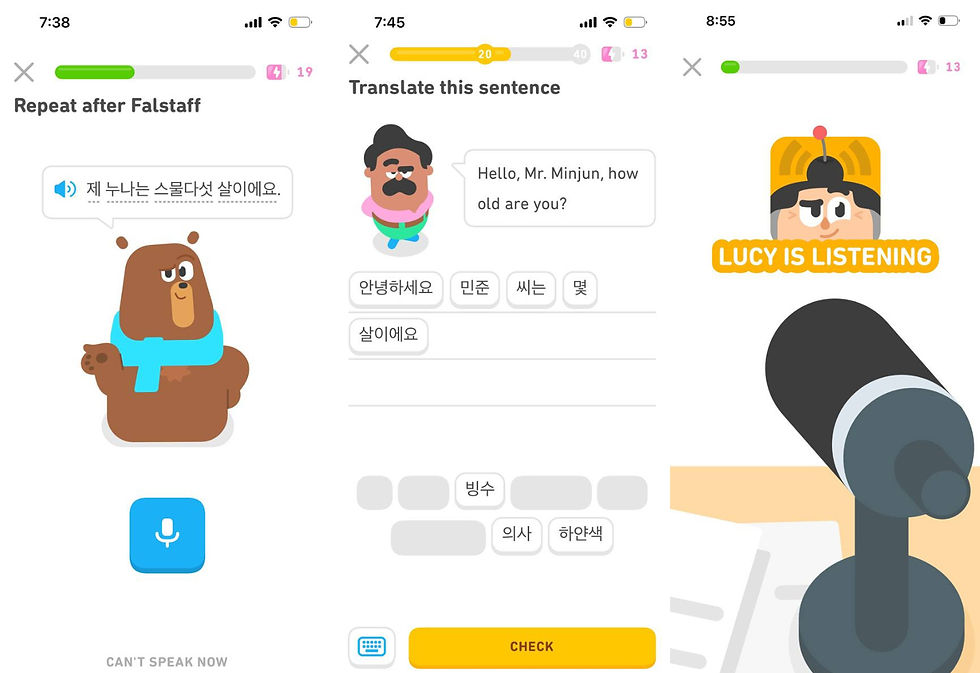
Keeping in touch with all these elements of language is so important, because just like how our muscles would atrophy if we do not engage them, our memory of the language would also slowly fade if we do not practice it.
This reminded me of my mother tongue, Chinese. Perhaps if you asked me to paraphrase this entire article in Chinese when I was taking the Chinese O Levels (and that is a LONG time ago), it would not have been that big of a challenge. But nowadays, I find myself struggling to recall how to write certain Chinese characters, and even maintaining a conversation with my Chinese-speaking grandparents is difficult at times.
This reflects the harsh reality of language-learning: If we do not use it, and do not practise it, any progress made can be undone in a matter of years.
Thus, to effectively learn a new language, it is crucial to consistently engage with the language in a variety of ways, whether it is talking to native speakers, watching dramas of that particular language, or in my case, using the trusty Green Bird.
My honest review
The app is honestly great for those seeking to try out a new language, and even better for those seeking to pass time. However, if you are trying to watch your favourite show without subtitles, attempting to make a conversation with an exchanger, or simply dreaming to retire in the farmlands of your dream country, maybe formal lessons would be a better idea.
[Gmail notification: Extend your 34-day streak! Your streak won’t extend itself!] Oh well, here we go again.
Written by: Rayden
Edited by: Neha, Joelle


Comments